SUS Parts for Japanese Food Machinery: Choosing Grade, Finish and Design Details
Materials / 18 Oct 2026

Food machinery drawings carry a particular set of notes. The grade is almost always stainless. The surface finish is tight. The edges are burr free. The cleaning instruction is explicit, and a short remark near the title block says something like “food contact surface”. These parts are not exotic: a nozzle, a bushing, a scraper holder, a cutter hub, a filling valve spindle. What sets them apart is that a mistake does not just fail an inspection. It becomes a place where product collects and bacteria grow.
This guide covers the choices that matter for machined SUS parts in food machinery drawn to Japanese practice.
Grade: start with the environment
Two grades handle most food work. The choice depends on what touches the part.
| Condition | Usual grade | Why |
|---|---|---|
| Dry food, flour, grains, packaged goods | SUS304 | Good corrosion resistance at lower cost |
| Wet food, moderate washdown, mild cleaners | SUS304 | Passive film holds up with rinsing |
| Salty, acidic or brine products such as pickles, sauces, seafood | SUS316 or SUS316L | Molybdenum resists chloride pitting |
| Chlorine based sanitizer, strong washdown | SUS316L | Higher pitting resistance |
| Parts that are welded into an assembly | SUS304L or SUS316L | Low carbon limits weld zone attack |
| Wear parts that need hardness | SUS420J2 or SUS440C, with care | Hardenable, but lower corrosion resistance |
The difference between SUS304 and SUS316 is explained in the SUS303 vs SUS304 vs SUS316 article, and the low carbon choice in the SUS316 vs SUS316L guide.
Free cutting SUS303 deserves a note. The sulphide inclusions that help the shop machine it are weaker against corrosion, and in a wet environment they become pit starters. Many food equipment buyers exclude free cutting grades from product contact parts. If the drawing asks for SUS303 on a food contact part, the engineer should ask whether that is intended.
Surface finish by zone
Not every surface of a machine needs a mirror. Drawings usually divide the part into zones, and the finish follows the zone.
| Zone | Meaning | Typical roughness target |
|---|---|---|
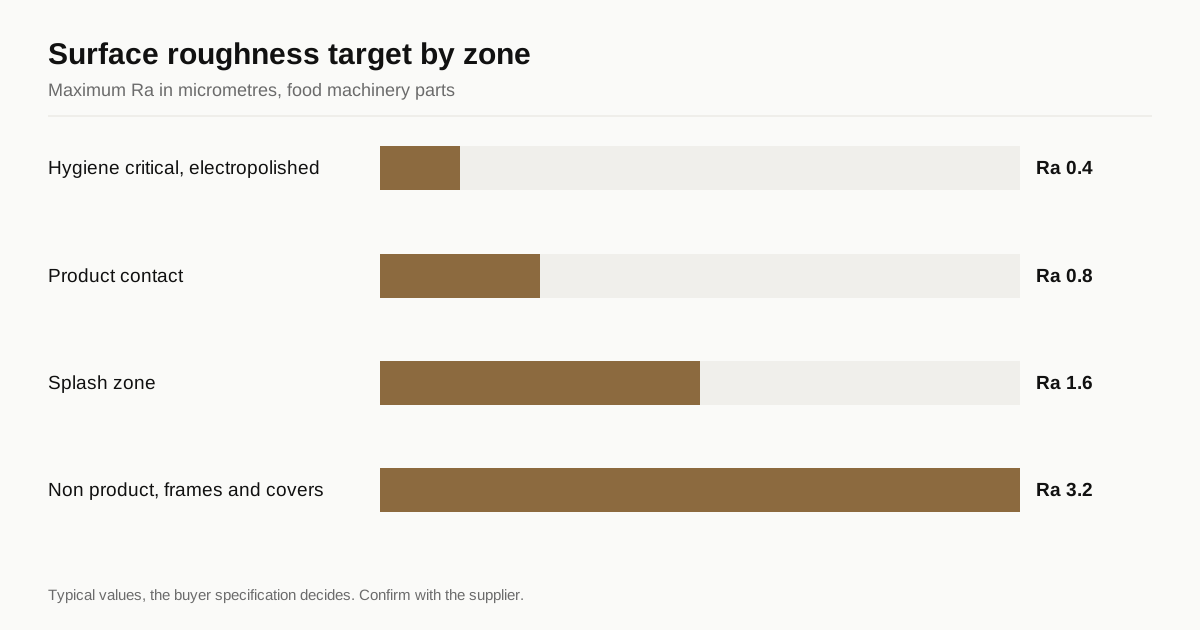
| Product contact | Touches the food directly | Ra 0.8 micrometres or smoother |
| Splash zone | Gets product or wash water but is not a contact surface | Ra 1.6 micrometres |
| Non product | Frames, covers and hidden surfaces | Ra 3.2 micrometres or as machined |
Hygiene critical equipment, such as aseptic filling or dairy and beverage lines, can call for finer finishes, often Ra 0.4 micrometres or less, with electropolishing as a last step. The tools in the surface finish guide help read the Ra, Rz and legacy triangle marks, and the converter gives the ranges. The drawing, not the shop, decides the number, and the quote should state the finish assumed.
A finish is a combination of the cutting method and the direction of the lay. A turned finish with a fine, circular lay is easy to clean. A coarse, scalloped surface left by a ball end mill holds residue even at the same average Ra. For contact surfaces, ask for the finishing method as well as the number.
Design details that matter more than grade
Internal radii. Sharp internal corners trap product and are hard to clean. Hygienic design guidelines commonly call for internal radii of about 3 mm or more on product contact surfaces. A drawing with a sharp internal corner on a food contact part is worth querying before the shop cuts it.
No crevices. A gap between two parts where liquid can enter and not leave is a harbourage. Faces that meet should seal, or be welded, or have a deliberate drain. Machined parts that mate should be flat and finished to close up the gap.
Threads out of the product zone. An exposed thread is a trap. Where a threaded part must sit in the product area, it needs a sealing washer or a design that keeps product out of the thread.
Burr free edges. A loose burr can end up in the product. The kaeri nashi guide describes the wording, the checks and the methods.
Dead legs and blind holes. A blind hole in a product zone fills and does not drain. Through holes and drain paths are preferred.
Surface treatment. Stainless food parts are passivated or electropolished, not plated. Chrome or nickel plating can flake and is not normally allowed on contact surfaces.
Typical part families
Food machinery uses the same few part families again and again, and each has a habit worth knowing.
Nozzles and spray tips. Small bores, often cross drilled, with burrs at the intersection. The bore finish decides how the spray pattern behaves and how the nozzle cleans. These parts are checked for burrs with a borescope or a magnifier, and the order should say so.
Bushings and guides. A bushing that carries a shaft in the product zone needs a fit that does not gall, which means a hardness or grade difference between the shaft and the bush. Two SUS304 surfaces sliding together at a close clearance gall quickly. See the fit guide for the clearance a precision fit leaves.
Scraper and cutter holders. Blocks with pockets, slots and threaded holes. The pocket corners need radii the cleaning team can reach, and the threaded holes need a blind hole design that drains or a seal.
Valve spindles and stems. Turned parts with a ground or polished sealing surface. Finish is critical and the part needs protection in packing so the surface is not scratched in transit.
Hubs, flanges and covers. Larger machined parts where flatness of the sealing face matters. The geometric tolerance guide explains how flatness is called out.
Cleaning and packing
Machined parts leave the shop with cutting oil and fine swarf on them. For food machinery that is not acceptable, and Japanese drawings usually carry a degrease and clean note, 脱脂洗浄. A good routine is:
- Deburr and remove loose swarf.
- Wash in a suitable detergent or solvent to remove cutting fluid.
- Rinse and dry.
- Passivate or electropolish if required, then rinse.
- Bag or wrap clean, in packing free of oils and paper that sheds fibres.
The passivation guide covers the treatment step. The packing step is where parts are most often spoiled. A clean part dropped into an oily bag arrives dirty. If the part has a food contact surface, ask for it to be packed separately from other parts, and say whether the buyer wants vacuum bags, desiccant or plain clean wrap.
Paperwork
Food machinery buyers usually ask for more than the parts. The common set is:
- Mill sheet showing grade and chemistry, traceable to the bar.
- Inspection report with the dimensions that matter.
- Surface finish record where the finish is specified.
- A statement of the material and treatment for the buyer’s own food contact file.
Material rules for apparatus that touches food are set by the country of use, and a Japanese buyer working to Japanese food law may have its own list of approved materials. The shop should not claim a food safety approval for the part. What it can do is supply the right grade, the right finish and the records that let the buyer make the claim. A line that says “food grade” without a standard behind it is a marketing phrase and not a specification.
Washdown chemistry in practice
Cleaning routines decide whether a grade lasts. A line that is washed daily with an alkaline detergent and a chlorine based sanitizer exposes every surface to chloride at some concentration. SUS304 resists dilute chlorine for short contact. Left wet, with a stagnant film of sanitizer in a crevice or a thread, it pits within weeks.
The practical points for a designer or buyer are these. Rinse after the sanitizer, because the damage comes from the contact time. Dry the parts if possible. Keep crevices out of the design. And choose SUS316L where the sanitizer is strong or contact is long, since the molybdenum gives real extra margin. The extra cost of SUS316L over SUS304 is small compared with replacing parts that pit.
Typical failures
- Pitting after a few weeks of washdown. SUS304 in a chlorine rich cleaner. The fix is SUS316L and a rinse step in the cleaning routine.
- Rust spots on a new part. Iron from a steel brush or fixture embedded in the surface, usually fixed by passivation and by keeping tools for stainless only.
- Product residue in a corner. An internal radius that is too small or a ball end finish that is too coarse.
- A burr in the product. An edge that was checked by sight and not by touch.
Checklist
- State the grade and the environment, wet or dry, salty or sweet, acid or neutral.
- Mark which surfaces are product contact and give the Ra for each zone.
- Specify internal radii, burr free edges and treatment.
- Add the cleaning and packing instruction.
- List the documents you need with the shipment.
To price a food machinery part, send the drawing. An engineer reads the grade, the finish zones and the cleaning note, asks about the environment if it is not stated and quotes within 24 business hours. The part is inspected before packing, and the quality page describes what ships with it.
Questions
Is SUS304 or SUS316L better for food machinery parts?
SUS304 is the normal choice for dry food contact and moderate washdown. SUS316L is chosen when the product is salty or acidic or when strong chlorine based sanitizers are used, because molybdenum improves pitting resistance.
What surface roughness do food contact parts need?
A common limit for product contact surfaces is Ra 0.8 micrometres or smoother, with finer finishes for the most hygiene critical equipment. The buyer's specification decides, and the drawing should state it.
Can free cutting SUS303 be used for food contact?
Many food equipment buyers exclude it, because the sulphide inclusions that help machining are weak points for pitting. If a drawing names SUS303 for a food contact part, confirm that this is intended.
Have a drawing for a stainless part?
Send it and an engineer reads the title block, quotes it within 24 business hours, and if you order we place, manage, inspect and ship the parts on one PO and one invoice.
Get a quoteRelated guides
SUS303Se and SUS303Cu Compared with SUS303: Which Free Cutting Grade to Use
SUS303Se and SUS303Cu against standard SUS303: what selenium and copper change for finish, cold forming and corrosion, and what a drawing should state.
SUS Spacers and Collars to JIS Drawings: What Drives the Price of Small Lots
How stainless spacers and collars are made from JIS drawings in small lots: length and parallelism, bore and set screw details, stack-up and price breaks.