SUS303Se and SUS303Cu Compared with SUS303: Which Free Cutting Grade to Use
Materials / 20 Oct 2026
SUS303 is the free cutting stainless that most buyers know: an 18 chromium, 8 to 10 nickel austenitic grade with sulphur added so that chips snap off and tools last. It is the easiest of the common stainless grades to turn. Japanese drawings, though, carry two close relatives that most purchasing teams have never ordered: SUS303Se and SUS303Cu. They solve problems SUS303 does not, and they come with their own conditions.
This guide explains what the extra letters mean, where each grade belongs and what to put on a drawing.
How free cutting stainless works
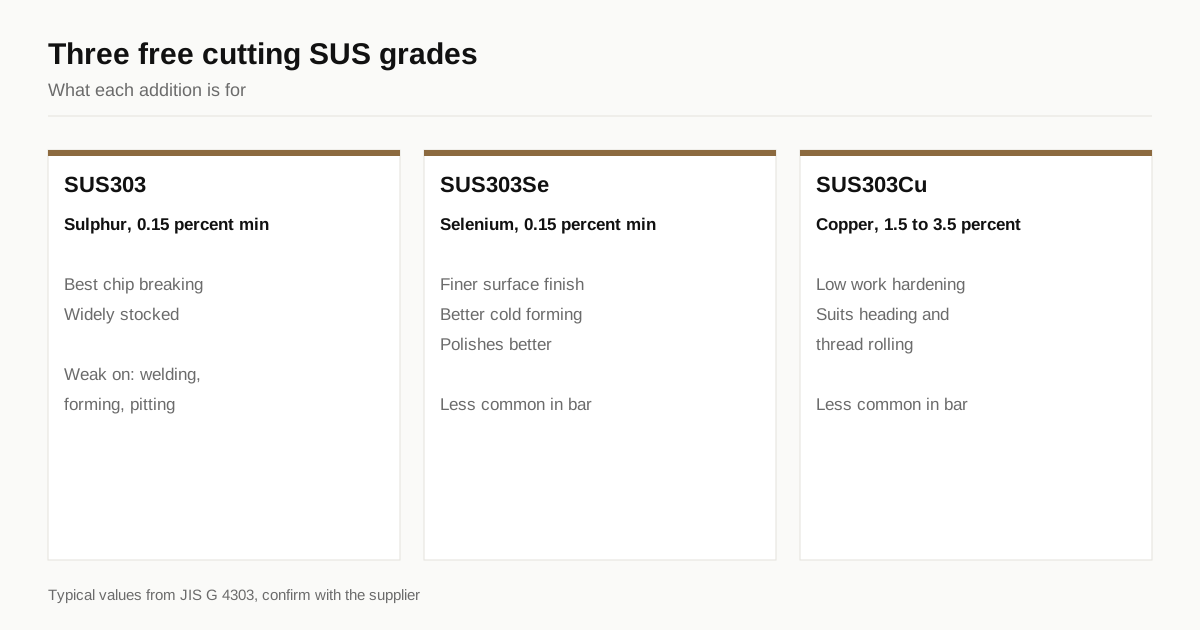
Standard SUS304 is tough and gummy. Chips curl into long ribbons that wrap round the tool, heat builds at the edge and tools wear fast. The free cutting fix is to add a small amount of a second element that forms soft inclusions. In SUS303 the element is sulphur, held at a minimum of 0.15 percent. The sulphur combines with manganese to make manganese sulphide stringers. The stringers act as built in chip breakers and lubricate the cut.
The trade is corrosion resistance. Sulphide inclusions interrupt the passive film where they reach the surface, and they become the starting point for pitting. SUS303 is noticeably less corrosion resistant than SUS304, and it does not weld well or form well. It is a machining grade, not a general purpose grade.
SUS303Se and SUS303Cu take different routes to a similar goal.
SUS303Se: selenium for finish
In SUS303Se, selenium replaces most of the sulphur. JIS sets the selenium at a minimum of 0.15 percent and holds sulphur low, around 0.06 percent at most. Selenide inclusions are rounder and finer than sulphide stringers, and that gives three benefits.
Better surface finish. A turned or milled surface is cleaner, with less tearing around inclusions. Finishes in the range of Ra 0.4 to 0.8 come more easily, and the surface takes a polish better than SUS303.
Better cold working. Round inclusions do not open as cracks when metal is bent, headed or upset. Selenium grades are used where a part is machined and also cold formed.
Slightly lower machining speed. SUS303Se cuts almost as freely as SUS303. The difference is small, and shops usually run both at similar settings.
SUS303Cu: copper for cold forming
SUS303Cu is SUS303 with copper added, with JIS giving a range of about 1.5 to 3.5 percent. Copper stabilizes the austenitic structure, which has two effects.
Lower work hardening. The metal does not harden as fast when it is deformed, so cold heading, thread rolling and forming are easier. This is the main reason the grade exists.
Less magnetism after cold work. Standard austenitic grades become slightly magnetic when cold worked, because some austenite turns to martensite. Copper bearing grades resist that change. The effect is real but it is not a guarantee of non magnetic behaviour, and a drawing that needs a defined magnetic limit should say what it is and how it is tested. See the SUSXM7 guide for the grades designed for it.
Side by side
| Property | SUS303 | SUS303Se | SUS303Cu |
|---|---|---|---|
| Added element | Sulphur, 0.15 percent minimum | Selenium, 0.15 percent minimum | Sulphur plus copper, 1.5 to 3.5 percent |
| Chip breaking | Excellent | Very good | Very good |
| Surface finish | Good | Better | Good |
| Cold heading and forming | Poor | Better | Best of the three |
| Polishability | Fair | Better | Fair |
| Corrosion resistance | Reduced against SUS304 | Reduced, slightly better than 303 | Reduced against SUS304 |
| Weldability | Poor | Poor | Poor |
| Typical use | Turned fittings, shafts, nuts | Parts needing fine finish or forming | Screws, cold headed parts, rolled threads |
| Availability in bar | Widely stocked | Less common | Less common |
Ratings are relative and typical. The SUS303 vs SUS304 vs SUS316 article gives the machinability comparison with the base grades.
What the drawing has to say
Free cutting grades are named in the material block and the name is a requirement. The drawing owner chose a grade for a reason, whether finish, forming or availability, and the shop does not get to swap one for another. If the drawing says SUS303, a bar of SUS303Se is a different grade with a different certificate. If a buyer wants to open the choice, the note should say so, for example “SUS303 or SUS303Se acceptable”.
The mill sheet carries the proof. For SUS303 it shows sulphur. For SUS303Se it shows selenium and a low sulphur figure. For SUS303Cu it shows copper. A mill sheet whose chemistry does not match the grade named on the order is a reject, and the engineer checks it when the material arrives. The certificates guide explains how to read one.
At the machine
All three grades cut well, and the settings that work for SUS303 are a good starting point for the other two. A few habits keep the benefit.
- Use the speed the grade allows. Free cutting stainless runs faster than SUS304, often by a wide margin in turning. A shop that treats it as SUS304 wastes the advantage and may produce a duller finish.
- Keep tools sharp. The grade forgives a worn insert more than SUS304 does, but a worn edge still tears the surface and shows up as a poor finish on a part where finish is the reason for choosing Se.
- Do not starve the cut. Free cutting stainless still work hardens, only less. A light finishing pass with too little feed rubs and burnishes.
- Watch the bar. Inclusion content varies from heat to heat, and an unusually coarse bar can leave streaks. If a surface shows lines along the bar axis that are not tool marks, it is worth checking the mill sheet and the next bar before the lot is finished.
The work hardening guide explains why a rubbing cut is the main danger on any austenitic stainless, free cutting or not.
A worked example
A buyer draws a small stainless fitting with a 12 mm hex, an M8 thread and a 3 mm cross hole. The drawing says SUS303. A shop can turn and drill it at high speed and the result is a good part for a dry indoor connector.
Now the same fitting is going into a washdown environment and the buyer wants a polished sealing face. SUS303 would work mechanically, but the sulphide inclusions at the sealing face give a surface that is hard to polish and a place for corrosion to start. SUS303Se gives a better polished face with a minor loss in turning speed. The better answer for a wet service may be SUS304 or SUS316, accepting slower machining for a part that will not pit. The grade choice and the service belong together, which is why the quote request should say where the part is used.
Take a different case: a small socket head screw machined from bar and then cold headed. Sulphur grade SUS303 would crack at the head on forming, and SUS303Cu will form cleanly. The copper grade is the right answer, and no amount of care at the machine fixes the wrong grade.
Finishing the parts
All three grades share a caution about passivation. The inclusions that make them cut well are soluble in some of the acid baths used for passivation. A bath chosen for SUS304 can dissolve sulphides at the surface and leave a pitted skin on a free cutting part. The usual answer is a bath and a time that suit the grade. The passivation guide covers the options, and the drawing should say which process and standard apply. A free cutting part that rusts after passivation is usually a process choice gone wrong, not a bad bar.
Electropolishing has the same issue and gives a less even result on free cutting grades. If a bright surface is needed, the grade choice should come first and SUS316L or SUS304L is often the right answer.
Where each grade belongs
- SUS303: turned parts in volume where finish is routine. Shafts, fittings, bushings, nuts and spacers in dry or mild service.
- SUS303Se: parts where finish matters more than the last few percent of cutting speed, or where the part is also formed or polished.
- SUS303Cu: screws, small fasteners and parts that are machined and then cold headed, rolled or crimped.
- None of the three: welded assemblies, marine or chloride service, food contact parts where a sulphide pit is a risk, and anything that needs full SUS304 corrosion resistance.
Supply and lead time
Standard SUS303 is held in many sizes. SUS303Se and SUS303Cu are made in smaller quantities and are stocked in fewer sizes, so they can take longer and need minimum quantities, which matters for a small lot. If the drawing allows a choice, ask the engineer what is available before settling on the grade. If it does not, plan for the lead time of the specified bar.
Checklist
- Use the full designation in the material block, SUS303Se or SUS303Cu, with JIS G 4303.
- Say whether the grade is fixed or open to a named alternative.
- Ask for a mill sheet that shows the added element.
- Name the passivation process if one is needed, and make sure it suits free cutting grades.
- Avoid free cutting grades for welded parts and chloride service.
To compare the options on a part, send the drawing. The engineer reads the material block, asks about the finish, forming and service questions that decide the grade and quotes within 24 business hours. The grade table lists the SUS grades we quote, and the equivalents guide maps them to AISI and EN names.
Questions
What is SUS303Se?
It is the SUS303 composition with selenium added in place of most of the sulphur. It cuts almost as freely as SUS303 and gives a better surface finish, and it tolerates cold forming and polishing better.
What is SUS303Cu used for?
SUS303Cu adds copper, which makes the austenite more stable and cuts work hardening. It suits parts that are machined and also cold headed or thread rolled, such as small screws and special fasteners.
Can I replace SUS303 with SUS303Se without asking?
No. The grade is a drawing requirement and the certificate has to match it. Some buyers accept the swap when the finish improves, but that is their decision and has to be recorded on the order.
Have a drawing for a stainless part?
Send it and an engineer reads the title block, quotes it within 24 business hours, and if you order we place, manage, inspect and ship the parts on one PO and one invoice.
Get a quoteRelated guides
SUS Spacers and Collars to JIS Drawings: What Drives the Price of Small Lots
How stainless spacers and collars are made from JIS drawings in small lots: length and parallelism, bore and set screw details, stack-up and price breaks.
SUS Parts for Japanese Food Machinery: Choosing Grade, Finish and Design Details
Which SUS grade and finish suit machined parts for Japanese food machinery: SUS304 or SUS316L, Ra limits, radii, burr free edges and cleaning before packing.