Japanese Drawing Notes Translated: The Phrases That Change a Stainless Order
Drawings / 12 Oct 2026
A Japanese drawing is more compact than most. It leans on short phrases that every Japanese draftsman knows and that a translation tool turns into long, vague sentences. The notes sit in the corner of the sheet, in small characters, and they hold the requirements that decide whether the part is accepted: the tolerance class that governs unlabelled dimensions, the edge condition, the surface treatment and the certificate that goes with the parts. If a note is missed or mistranslated the part may still be made correctly to the dimensions and be rejected anyway.
This guide lists the notes that appear on stainless part drawings, gives the reading and the plain meaning, and says what a shop does for each.
How to read a note
Notes are short and follow a pattern. A subject, then an instruction. The sentence often ends in のこと (no koto), which marks a requirement that must be followed. Another common ending is とする (to suru), meaning “is to be”. Both are firmer than a descriptive sentence, so a translation that softens them to “should” has changed the requirement.
Parentheses around a dimension, such as (25), mark a reference dimension (参考寸法, sankō sunpō). It is given for information, not to be inspected against a tolerance. Treating a reference dimension as a controlled one adds inspection work and sometimes rejects good parts.
Tolerance and general notes
| Japanese | Reading | Meaning | What a shop does |
|---|---|---|---|
| 指示なき寸法公差は JIS B 0405 中級 | shiji naki sunpō kōsa wa JIS B 0405 chūkyū | Unspecified tolerances follow JIS B 0405 class m (medium) | Applies class m limits to every unlabelled size |
| 精級 / 中級 / 粗級 | seikyū / chūkyū / sokyū | Fine (f) / medium (m) / coarse (c) class | Looks up limits by class and size band |
| 公差 | kōsa | Tolerance | Reads the limits beside the size |
| 参考寸法 | sankō sunpō | Reference dimension, shown in brackets | Does not inspect it as a requirement |
| 指示なきRはR0.5 | shiji naki R wa R0.5 | Unspecified radii are R0.5 | Cuts a 0.5 mm radius on inside corners |
| 全周 | zenshū | All around | Applies the call-out to the full outline |
The general tolerance classes are explained in the JIS B 0405 and B 0419 guide, and the calculator converts a size and class to limits.
Edges, finish and treatment
| Japanese | Reading | Meaning | What a shop does |
|---|---|---|---|
| 糸面取り | itomentori | Very small edge break | Cuts about 0.1 to 0.3 mm, confirmed on the quote |
| 面取り | mentori | Chamfer | Cuts the chamfer given, such as C0.5 |
| バリ取りのこと / カエリなし | baritori no koto / kaeri nashi | Deburr, no burrs | Removes burrs, checks edges |
| 表面粗さ | hyōmen arasa | Surface roughness | Reads the Ra or Rz value or triangle marks |
| 研磨 / 磨き | kenma / migaki | Polish | Applies the finish given, confirms the grit or Ra |
| 梨地 | nashiji | Matte, fine textured finish | Bead blast or similar, sample agreed |
| 不動態化処理 | fudōtaika shori | Passivation | Sends the part to a passivation line after machining |
| 電解研磨 | denkai kenma | Electropolishing | Allows for stock removal, confirms the order of steps |
| 脱脂洗浄 | dasshi senjō | Degrease and clean | Washes the parts before packing |
These match the topics covered in the itomen guide, the kaeri nashi guide and the passivation article.
Material, inspection and delivery
| Japanese | Reading | Meaning | What a shop does |
|---|---|---|---|
| 材質 | zaishitsu | Material | Orders the grade named, for example SUS304 |
| 材料証明書 | zairyō shōmeisho | Material certificate | Supplies a mill sheet for the lot |
| 検査成績書 | kensa seisekisho | Inspection report | Measures and records the listed dimensions |
| 全数検査 | zensū kensa | 100 percent inspection | Measures every piece, not a sample |
| 非磁性 | hijisei | Non-magnetic | Checks grade and condition, tests with a magnet |
| 刻印 | kokuin | Stamped marking | Stamps the mark at the location shown |
| 梱包 | konpō | Packing | Packs as the note says, with separators or bags |
The material certificates guide explains what a mill sheet carries, and the seisekisho article covers the inspection report.
Where the notes sit on the sheet
Notes are not in one place. A Japanese sheet usually has four zones, and a note in any of them is binding.
- The title block, bottom right. Part name, drawing number, material, scale, projection symbol, general tolerance class, surface treatment and quantity often sit here, each in a labelled box.
- The notes block, often just above or to the left of the title block. Numbered notes cover general requirements: unspecified tolerances, unspecified radii, edge condition, cleaning and packing.
- The revision block, top right. It lists what changed and when. The latest entry governs.
- The views themselves. Local notes with leader lines tell the shop what to do at one feature: a thread, a finish, a stamp, a polish on one face.
A buyer who sends a cropped screenshot or a drawing without the title block removes the requirements that matter most. Send the full sheet at full resolution.
Three notes and what they cost
Some notes look minor and have a clear effect on price.
不動態化処理 (passivation). It adds a processing step after machining and usually a trip to a specialist line, which adds days to the lead time. If the drawing also carries a mill sheet requirement, the engineer plans the order of steps so the parts are cleaned, deburred and treated in that sequence.
全数検査 (100 percent inspection). On a batch of 500 parts this is a different job from a sample. Each piece is measured and the results are recorded. The inspection time can approach the machining time for a simple part. The quote states it, and the buyer can choose a sampling plan if the part does not need full inspection.
非磁性 (non-magnetic). Austenitic stainless is only nearly non-magnetic and becomes slightly magnetic after cold work. A note asking for non-magnetic parts needs a grade choice, a statement of how the magnetism is tested and an agreed limit. The drawing owner should say which. Without that the shop can only cut the part and hope.
Where translation goes wrong
Short phrases lose their object. 面取り alone means a chamfer, but it does not say how large. The size may be in the notes block, in a table elsewhere on the sheet or nowhere at all. The translator needs to read the whole sheet, not one line.
The same word means different things. 仕上げ (shiage) is “finish”, and it may mean a machined finish, a polished surface or a finishing cut. The context and the surrounding symbols decide which. On a drawing with a surface roughness symbol, shiage refers to the roughness. On one without, it can mean “finish machining” before a grind.
Old notes carry old standards. A note citing a withdrawn JIS number is still a valid instruction, but the current standard may have different values. The engineer should flag it and confirm which edition the owner intends.
Abbreviations are local. Companies use their own house abbreviations, sometimes in katakana, sometimes in letters. A shop that has never seen them will guess. The right step is to ask.
Part numbers, revisions and dates look like notes. Revision blocks and change notes list what changed between versions. They matter when two sheets arrive for the same part, because the later revision governs.
Handling a drawing with unclear notes
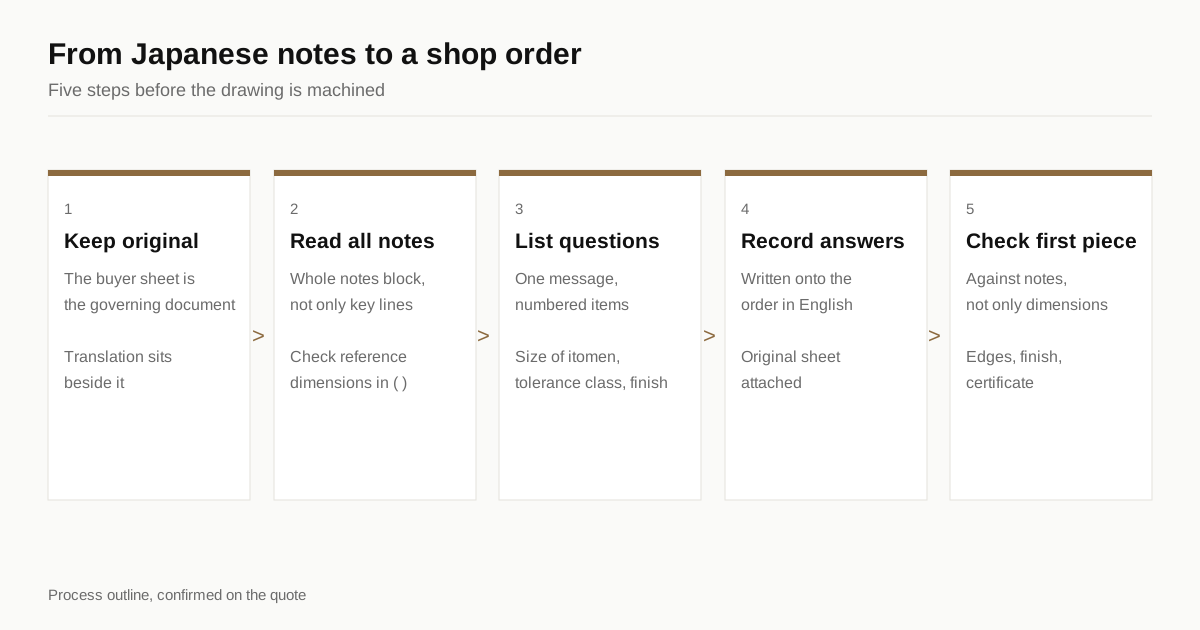
- Keep the original sheet. It is the legal document. Any translation sits beside it.
- Translate the notes block in full, not only the lines that look important. Notes are short and cheap to read in full.
- List questions in one message. A single email with five numbered questions gets a better answer than five separate ones.
- Record the answers on the order. The shop works from the order, so the clarification must be on it.
- Check the first piece against the notes, not only the dimensions.
When you send a Japanese drawing, you do not need to translate it first. The engineer reads the title block and the notes, lists any that are unclear and replies with questions along with the quote within 24 business hours. If you order, the notes that govern machining and inspection go onto the order in English, with your original sheet attached, and the engineer follows the part against them. The drawing checklist covers other items to check before sending.
Questions
Can I run a Japanese drawing through machine translation and send it to a shop?
It helps for a first look, but it is not enough for an order. Machine translation turns short drafting phrases into soft sentences and sometimes drops the ending that makes a note mandatory. The requirement should be translated by someone who reads drawings.
What does the ending no koto mean on a note?
The ending のこと marks an instruction that must be followed, as in deburr all edges. A note without a clear ending is usually a description, not a requirement, but a drafter may not have meant that.
Should I send the original drawing or a translated copy?
Send the original. A translated copy can be added beside it, but the shop and the inspector should always have the buyer's own sheet in hand.
Have a drawing for a stainless part?
Send it and an engineer reads the title block, quotes it within 24 business hours, and if you order we place, manage, inspect and ship the parts on one PO and one invoice.
Get a quoteRelated guides
SUS303Se and SUS303Cu Compared with SUS303: Which Free Cutting Grade to Use
SUS303Se and SUS303Cu against standard SUS303: what selenium and copper change for finish, cold forming and corrosion, and what a drawing should state.
SUS Spacers and Collars to JIS Drawings: What Drives the Price of Small Lots
How stainless spacers and collars are made from JIS drawings in small lots: length and parallelism, bore and set screw details, stack-up and price breaks.